Katyayan K.
Chemical Engineering UG ’26
Kanpur
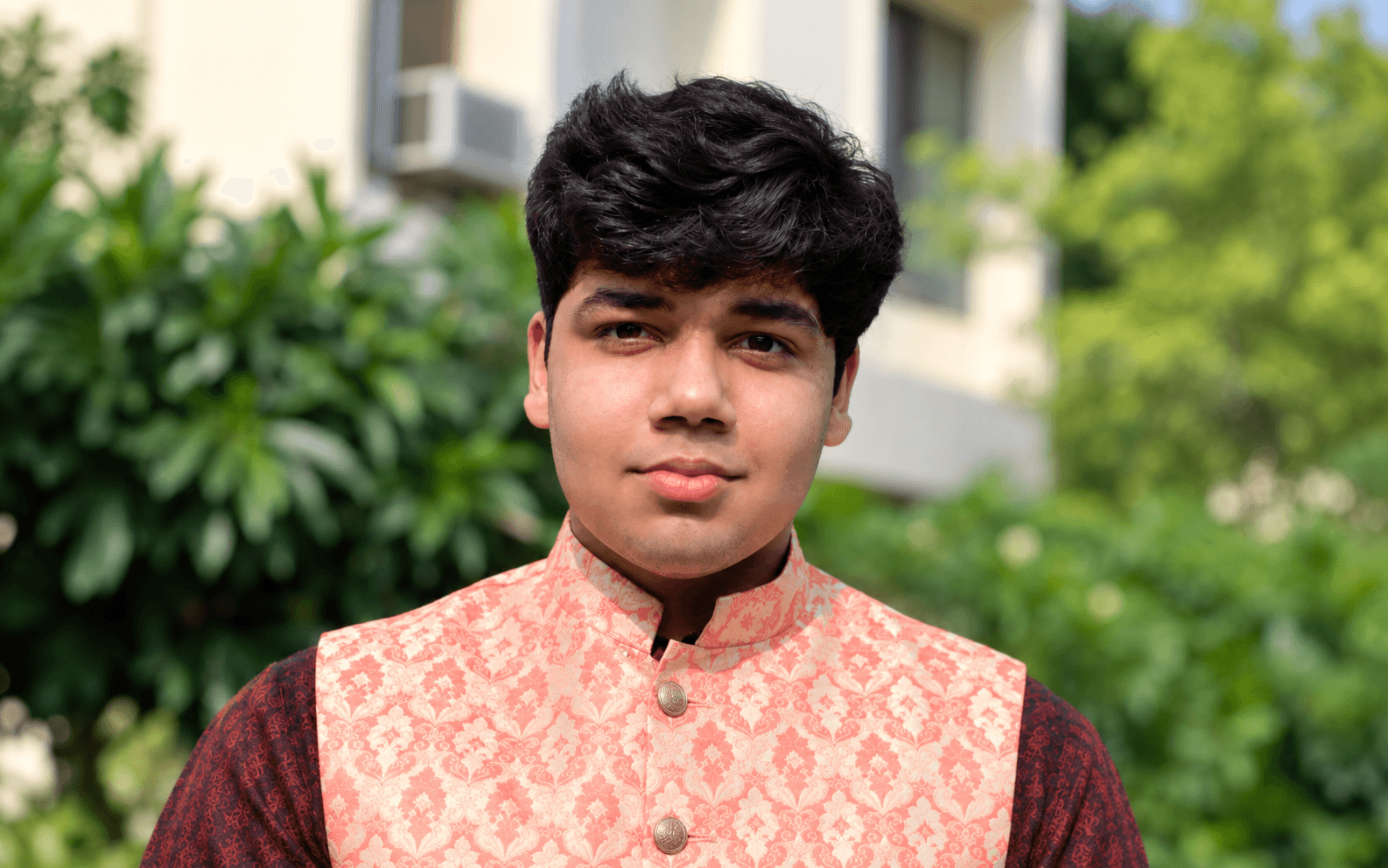
Explored chemistry through industry, theatre and a life-saving prototype — and found his story.
Accepted to:
Georgia Tech

Uah case studies
Chemical Engineering UG ’26
Kanpur
Explored chemistry through industry, theatre and a life-saving prototype — and found his story.
Accepted to:
Georgia Tech
Katyayan was the kind of student who rarely accepted that something simply “worked” without asking why. His fascination with Chemistry grew through visits to industrial plants and gradually became an interest in how science could be applied to real-world problems. At the same time, he had a very different side: he loved football, poetry and theatre and eventually became the Boy-in-Charge of his school’s Hindi Dramatics Society. He was also involved in debating, MUN, publications and social service. For Katyayan, these were not separate worlds. Whether he was understanding a chemical process, preparing for a role or taking responsibility for a team, he was drawn to understanding things deeply and then acting on them.
Katyayan’s challenge was not a lack of interest; it was deciding how these different parts of him could come together. Chemistry and Physics pointed towards engineering, while theatre, poetry, debating and writing revealed a strong creative and communicative side. His experiences in industrial settings had also given him a practical understanding of how scientific ideas become processes, products and solutions. The UAH mentor’s role was to help him explore these interests without prematurely narrowing his identity to “a student who wants to study Chemical Engineering.” Over two years, the focus was on helping him ask better questions, pursue meaningful projects, develop academic depth and understand what genuinely attracted him to engineering. As applications approached, those experiences had to become a clear and convincing story.
The UAH mentor began by encouraging Katyayan to look at problems around him as opportunities to learn. Instead of simply collecting activities, he was pushed to understand the process behind his interests and develop ideas that could be explored through research, prototypes and real-world experiences.
His interest in Chemistry became increasingly practical. Through internships at Alembic Pharmaceuticals, Bhavya Gases and SRF, he saw how chemistry moved from theory to industrial production, quality control, process engineering and scale-up. The mentor encouraged him to stay curious about these processes rather than treating the internships as résumé items.
During the Covid oxygen shortage, this curiosity led to one of his most significant projects: a working oxygen concentrator prototype using Pressure Swing Adsorption and a zeolite molecular sieve. The mentor helped him document and think through the engineering behind the project, turning it into evidence of how he approached problems rather than simply another achievement.
At the same time, the UAH mentor ensured that Katyayan did not lose the parts of himself that had nothing to do with Chemistry. He continued with Hindi and English dramatics, debating, poetry, MUN and publications, eventually becoming Boy-in-Charge of Hindi Dramatics and directing the Founder’s Day production.
As Grade 12 approached, mentoring focused on complete application support and completion of un-finished projects in initial months of Grade 12. Most importantly, the mentor helped Katyayan identify the narrative anchors connecting his experiences. His Common App essay focused not just on the oxygen concentrator, but on his response to failure—revealing his persistence, scientific curiosity and instinct to solve through iteration.
Katyayan was admitted to the Georgia Institute of Technology, where he went on to pursue Chemical Engineering.
His application brought together two sides that could easily have appeared unrelated: the student fascinated by chemical processes, industrial systems and practical engineering, and the young dramatist who found meaning in performance, leadership and communication.
UAH’s founders will tell you honestly what you need — even if the answer isn’t us.
A free 30-minute diagnostic call. No commitment.
Ready to get started?
Book a callWe use cookies
Some keep the site working. Others tell us which resources families actually read. You can accept everything, decline the optional ones, or choose for yourself — declining will not affect your access to any part of this site.